
Interquartile Range (IQR): Definition, Calculation, Practice Problems
Learn what the Interquartile Range (IQR) is and how to calculate it, with worked examples and practice problems.
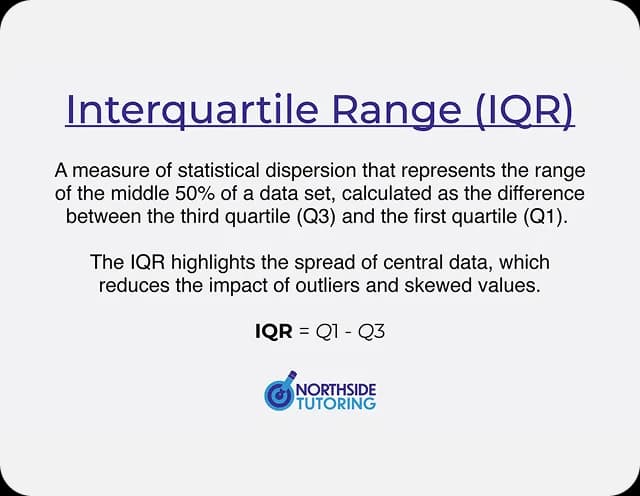
The Interquartile Range (IQR) is one of the most important measures of spread in statistics. It shows up in Algebra 2, AP Statistics, the SAT, the GRE, and every introductory psychology and biology methods course — so it's worth nailing down.
What is the IQR?
The IQR is the difference between the third quartile (Q3) and the first quartile (Q1) of a dataset:
IQR = Q3 − Q1
It captures the spread of the middle 50% of your data, which makes it robust against outliers.
Step-by-step: how to calculate
- Order the data from smallest to largest.
- Find the median — that's Q2.
- Find Q1 — the median of the lower half.
- Find Q3 — the median of the upper half.
- Subtract:
IQR = Q3 − Q1.
Worked example
Dataset: [3, 7, 8, 12, 14, 18, 22, 25, 30]
- Median (Q2) = 14
- Lower half:
[3, 7, 8, 12]→ Q1 = (7 + 8) / 2 = 7.5 - Upper half:
[18, 22, 25, 30]→ Q3 = (22 + 25) / 2 = 23.5 - IQR = 23.5 − 7.5 = 16
Why IQR matters
- Box plots use Q1, Q2, Q3, and the IQR to summarize distributions visually.
- Outlier detection: anything below
Q1 − 1.5 × IQRor aboveQ3 + 1.5 × IQRis typically flagged as an outlier. - IQR is less sensitive to extreme values than the standard deviation — handy when your data has outliers.
Practice problem
Find the IQR of: [5, 9, 11, 13, 14, 17, 20, 21, 22, 25].
Show answer
- Median between 14 and 17 = 15.5
- Q1 (lower 5:
[5, 9, 11, 13, 14]) = 11 - Q3 (upper 5:
[17, 20, 21, 22, 25]) = 21 - IQR = 21 − 11 = 10
Struggling with AP Stats or the Digital SAT's data section? Book a session with one of our AP Stats specialists.
Ready to begin?
Start tutoring with Northside.